

The Interactive Advertising Bureau (IAB) Europe updated its Transparency & Consent Framework (TCF) with the TCF 2.4 release, pairing Policies 5.0.b with Technical Specifications 2.4 and an updated Global Vendor List (GVL), published on 23 July 2026.
This is an incremental update to TCF 2.3, aiming to support user transparency by improving clarity around choices, while also giving publishers more flexibility to handle consent across multiple devices.
This article covers what changes, who it affects, and what to check before then.
What is the Transparency and Consent Framework (TCF)?
The TCF is a framework created by IAB Europe to help all parties involved in displaying and managing digital ads to be compliant with the European Union’s General Data Protection Regulation (GDPR) and ePrivacy Directive (ePD). Although it is voluntary, it helps organizations standardize how CMPs collect and store user data.
Historically, the TCF has had several version updates, and each release has changed how consent is obtained, increasing transparency and keeping the process user-centric.
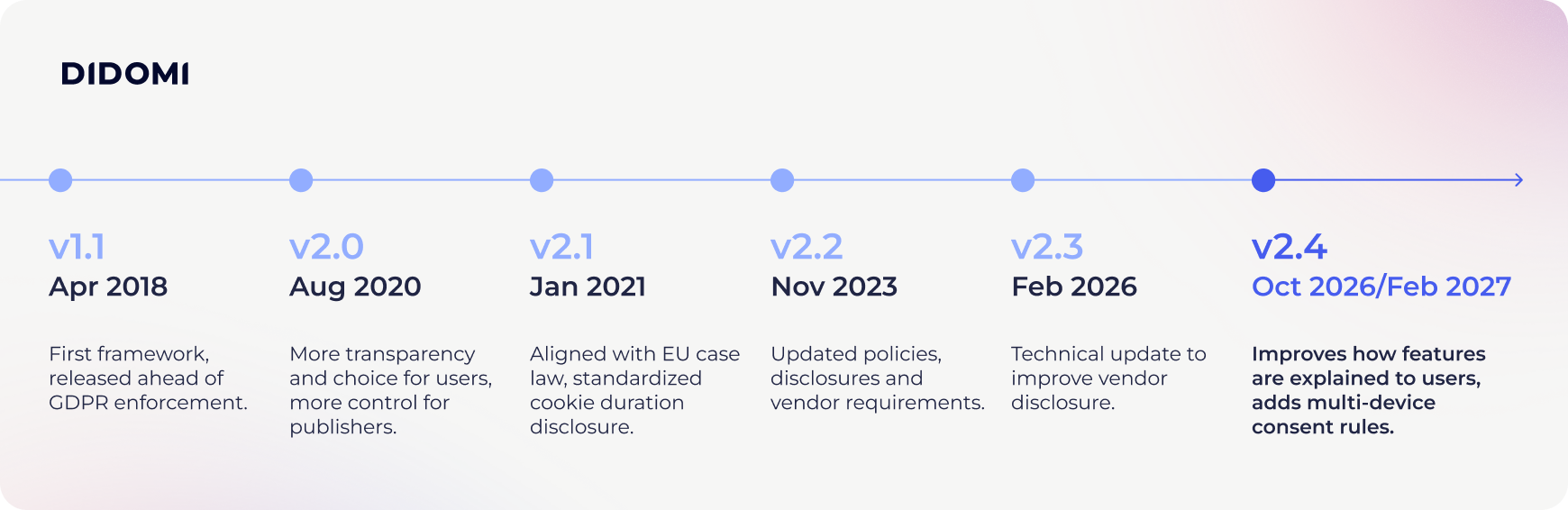
The latest update is less about vendor disclosure, which was the focus of 2.3, and more about what users actually read in the notice. Find the details in the next section.
TCF 2.4: What changes from the TCF 2.3
The following changes have been introduced by TCF 2.4 to be part of the consent notices:
- Standard explanation for features: This update helps users understand how each feature differs from purposes and why it doesn't offer user controls. The features that need the standard text are:
- Match and combine offline data sources
- Link multiple devices
- Receive and use automatically-sent device characteristics for identification
The standard explanation for features will be pulled directly from the IAB Global Vendor List (GVL) and cannot be modified. An official illustration is available for each feature, and they should not appear next to a control that can’t actually be switched off to avoid misleading users.
- The special feature 2 gets renamed: “Actively scan device characteristics for identification” is now “Identify devices based on information actively requested”.
- Consent across devices: As a part of Policies 5.0.b, the notice must inform users how far their choices apply beyond the device in front of them, and publishers get flexibility when signals conflict. This updated policy only applies to publishers that offer the ability to sync consent across multiple devices.
- One less workaround for special-purpose vendors: Vendors declaring only special purposes may be removed from the vendor legitimate interest section of the TC string, as their disclosure is already communicated through the mandatory disclosed vendors section introduced in the TCF 2.3. Implementation of this change is optional for CMPs.
To see how these changes play out in practice, here is a side-by-side comparison of 2.3 and 2.4:
TCF 2.3 vs 2.4 at a glance
TCF 2.4 deadlines and checklist
The transition to TCF 2.4 is divided into two waves depending on the platform environment.
The CMPs must adhere to the following deadlines:
- Web environments (Desktop and Mobile Web): 23 October 2026
- Native environments (Mobile apps and Connected TV (CTV): 23 February 2027
While for web environments most of the work sits with the CMPs, here is a list of action items that are worth checking on your end.
For publishers:
- Confirm with your CMP that your web setup will be on TCF 2.4 before 23 October 2026.
- If you use custom texts, make sure the standard explanation and illustrations show up unedited and in every language you serve.
- Check custom layouts: no toggle to appear next to a feature.
- If you sync choices across devices, double-check that users are told that their choices are applied beyond the device they are on through the notice. If you don’t, no action is required.
Since the enforcement date for mobile app and CTV environments is 23 February 2027, keep an eye out for guidance from your CMP to ensure your setup is fully updated to TCF 2.4 prior to the deadline.
For vendors:
- If you declare special feature 2, review the updated name and guidance.
- If you declare only special purposes, don’t assume legitimate interest is set in the TC string. IAB has dropped the requirement, but each CMP can choose to keep it. Reading the disclosed vendors section is more reliable.
- If you consume the GVL, make sure you handle the new standardTexts field.
How to prepare for the TCF 2.4?
What you need to do depends on your current setup. Here are the three most common scenarios:
- You’re a Didomi customer: Web notices have moved to TCF 2.4 automatically on 21 October, 2026, two days before the IAB deadline. Going forward, new and existing notices default to 2.4. Our team always keeps you informed of any changes, so watch out for past and future communications, and find more information in our technical documentation.
- You use another CMP: Check that they are compliant with the TCF 2.4 before the deadline. If you're looking for another provider, learn about our simple migration process.
- You don’t use a CMP: Consider whether you should adopt one, especially if you work with TCF vendors. Take a look at our CMP comparison list to find the one that matches your needs.
Learn more about the TCF 2.4 in our help center and on the IAB Tech Lab website. To reach out to our team of experts, book a call:
{{talk-to-an-expert}}