.svg)




A pioneer and French leader in online sales of new, original automotive spare parts, Oscaro operates across France, Spain, Belgium, and Portugal with a catalog of more than one million part references. France accounts for 90% of the group's commercial activity.
The platform welcomes 5 million users and 6 million sessions every month across its four markets.
Maxime Donnet, Analytics & CRO Manager at Oscaro for two years, oversees the company's entire web and app scope, from compliance to conversion. He led the migration to the Didomi CMP and Addingwell's server-side tracking alongside the IT, front-end, and analytics teams. The project was run as a full infrastructure initiative, and the resulting reliable measurement delivered more value than expected.
Server-side isn't a marketing tool, it's an infrastructure project. You have to align IT, front-end, and analytics. Thanks to the synchronization between Didomi and Addingwell, we secured the tracking of our commercial margin and made our tracking data reliable across all our markets."
- Maxime Donnet, Analytics & CRO Manager, Oscaro
Challenge: Moving away from in-house privacy and tracking
Before Didomi and Addingwell, Oscaro managed consent and the reporting of its marketing and analytics tags (GA4, Google Ads, Meta) internally. Faced with increasingly frequent regulatory and technical changes, the company chose to focus its development resources on its core business and rely on market solutions capable of keeping pace with regulation.
With a Consent Management Platform (CMP), the priority was to give marketing teams back the ability to edit the banner, add or remove a vendor, and track their metrics without going through an IT ticket.
On the tracking side, the ambition went beyond simple signal collection. Managing commercial margin represented a high-value use case, but one that was difficult to exploit on the client side. Routing business indicators through the browser raises a confidentiality issue, since a site's data layer and source code remain readable by any knowledgeable user. To make full use of this data, it had to be processed where it is protected: server-side.
Solution: A marketing-driven CMP, on-premise server-side on GCP
Oscaro chose two complementary building blocks: the Didomi CMP to regain control over consent, and Addingwell's server-side tracking, deployed on-premise in its own Google Cloud Platform environment, to make data reporting more reliable and secure.
Addingwell: outsourcing the expertise, keeping control
Setting up a server-side tagging infrastructure is one thing. Getting the real benefits from it, handling ad blockers, responding to ITP, or setting first-party cookies, is another. This requires dedicated skills to configure and operate the infrastructure, along with rigorous monitoring. A seemingly minor change to a tag or event can silently interrupt data flow to Meta or another vendor without anyone noticing.
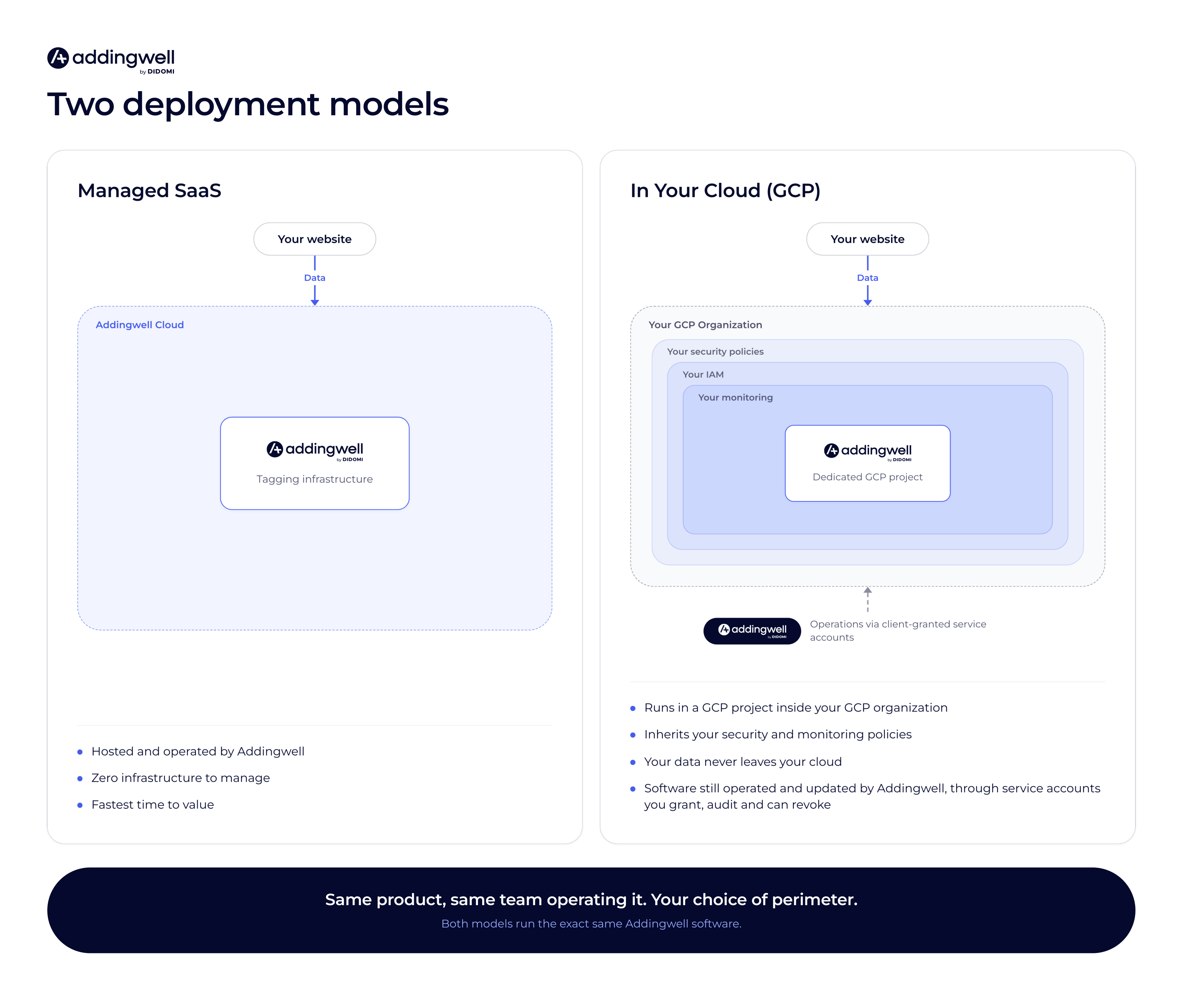
Addingwell's on-premise offering addresses this. The server-side setup is deployed within Oscaro's own Google Cloud Platform environment and managed under its own billing account. IT retains control of the infrastructure, tracks server costs in real time, and defines its own security level. Addingwell continuously contributes its expertise in infrastructure management, support, monitoring, and alerting, with a stack that is kept up to date. The project remains governed by Oscaro and orchestrated by Addingwell.
Business teams also benefit from this model. They rely on Addingwell's support to feed tags and activate new use cases, without tying up the internal ticket queue on tagging issues.
The economics confirmed this choice. The on-premise model comes out to roughly half the cost of the SaaS offering, and the infrastructure costs observed turned out to be significantly lower than initial estimates.
Didomi: a CMP driven by marketing teams
The logic is the same on the CMP side. With Didomi, marketing teams edit the banner, add or remove a vendor, and track their metrics independently. The choice fell on a French solution, capable of more tightly synchronizing consent and tracking information between the two platforms — a criterion that would later prove decisive.
On the UX side, the banner was customized with text and imagery representative of the automotive sector. Oscaro runs one A/B test per year to balance transparency against the consent rate obtained. The latest test compared two banner architectures with different levels of prominence given to the decline option. The version generating a noticeably larger loss of consent was ruled out, and the current configuration was confirmed.
.webp)
For Maxime Donnet, transparency doesn't stop at the banner interface:
Didomi lets us expose granular choices by purpose and by vendor across our four domains, with a 'Manage my cookies' link permanently accessible in the footer, and a cookie policy kept up to date with every change to the stack.
- Maxime Donnet, Analytics & CRO Manager, Oscaro
This transparency is verified in practice. The site's behavior is regularly audited across its three states, before consent, refused, and accepted, across all tools, and consent statuses are propagated to each vendor (Google Consent Mode, the Microsoft equivalent, Wizaly consent states).
A structured rollout for a controlled transition
The rollout was prepared as an infrastructure project, with upfront alignment across three teams: the roadmap team, to schedule the launch outside of key commercial periods; the technical team, to ensure everything was operational on launch day; and the analytics team, to support the shift in measurement reference points.
Oscaro chose a direct transition, with no dual-run period between the old and new setups. This was an important methodological point, since server-side tracking structurally collects more data. Comparing before and after without precaution would have distorted the analysis. The analytics team therefore established an average based on data collected after the migration, then applied a correction coefficient to the historical data until a complete history could be rebuilt.
Onboarding was very good, with regular check-ins to validate or unblock the setup when needed. Post-onboarding, the support team is responsive whenever questions come up around server-side.
- Maxime Donnet, Analytics & CRO Manager, Oscaro
Technical execution was fast: four domains configured in one day, GA4 server-side and Google Tag Manager deployed in under a week.
Results: more reliable tracking, protected margin
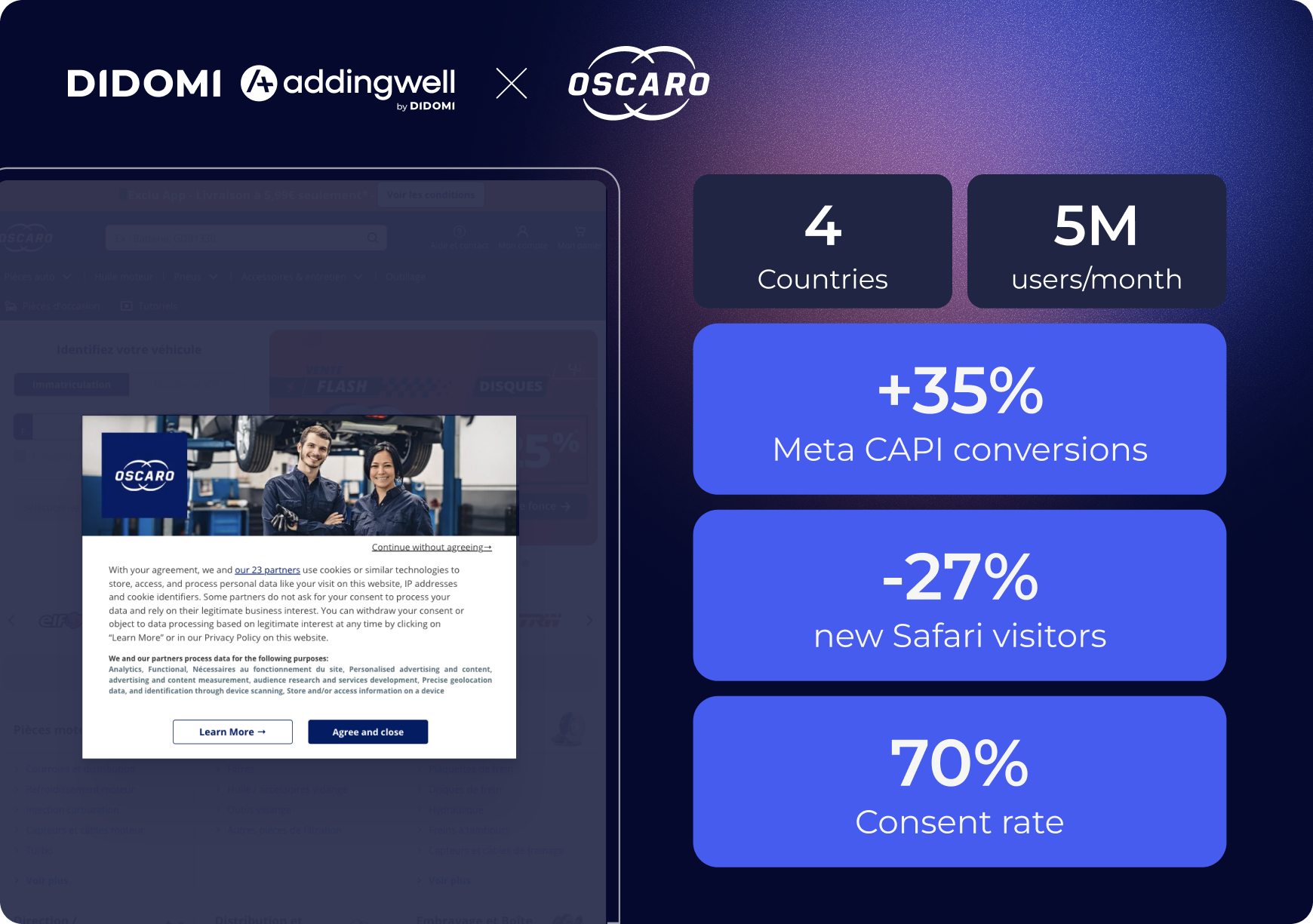
Before Didomi, there was no reliable baseline to estimate Oscaro's consent rate. The first gain, then, is the ability to steer this metric. It is now tracked weekly and continuously optimized, currently standing at around 70% on the French market, the group's largest.
Hidden bugs brought to light
Beyond the expected gains, the new measurement chain revealed value that was less anticipated: it exposed what the previous setup simply couldn't see.
Feeding Didomi's consent data into Addingwell first revealed inconsistencies, which led to identifying a pageview tag bug that was invisible on the client side. Teams from Oscaro, Didomi, and Addingwell analyzed and fixed it together.
Analyzing the post-migration gains browser by browser then showed that on certain browsers equipped with ad blockers, the CMP itself was being blocked. Without a banner, no consent can be collected, so no tag fires. The fix, routing the CMP's SDK through Didomi's reverse proxy, is currently being rolled out and is expected to further improve collection, particularly on Safari.
Measurement reliability and media impact
On measurement reliability, the gap between GA4 and the back office was cut in half, dropping from around 10% to 4-5%. These gains translate directly into media performance, with +35% additional conversions captured by Meta CAPI compared to the pixel alone, +3% average Google Ads conversions, and around +8% additional traffic measured over the period thanks to the CDN and the bypassing of blocking mechanisms.
The Safari case: a correction, not a loss
The most counter-intuitive figure is also one of the most telling with-27% new visitors on Safari. This isn't a loss, it's a correction cause bITP's seven-day cap was counting returning visitors as new ones, meaning more than one in four "new" Safari visitors wasn't actually new. Setting the GA4 cookie as first-party via Addingwell restored an accurate view of the audience, a significant issue given that iOS traffic older than eight days accounts for around 40% of Oscaro's traffic, a volume comparable to Chrome's.
Technical performance and protected margin
On the technical performance side, the JavaScript weight of pages decreased by around 10% with the removal of browser-side tracking. Overall load time remains stable at this stage, with a more detailed Core Web Vitals analysis still to be carried out.
Finally, commercial margin tracking is now handled server-side. This high-value use case can be exploited without business data ever passing through the browser.
Oscaro's recommendations for a successful rollout
From this experience, Maxime Donnet draws three recommendations for any company considering a similar project:
- Treat the topic as a genuine, structuring project, aligning IT, front-end, and analytics from the very start.
- Lock in your baseline metrics before going live, especially in the absence of a dual-run period.
- Set realistic expectations for the expected gains, which measurement will later help objectively confirm.
And one technical recommendation, straight from the field:
Go all the way with the first-party logic. Dedicated subdomains, and route the CMP's SDK through the reverse proxy too, otherwise the CMP itself can be blocked by certain blockers, and all downstream measurement disappears with it. We experienced this firsthand.
- Maxime Donnet, Analytics & CRO Manager, Oscaro
If you'd like to learn more about how Didomi and Addingwell can support your organization on its compliance and data performance challenges, book a meeting with one of our experts:
{{talk-to-an-expert}}