.svg)




Retail rarely sells in a single session. Customers discover a product on their phone, compare options on a laptop a few days later, and come back the following week to buy, which is precisely the kind of journey today's measurement struggles to hold onto.
Along the way, signals get fragmented, collected without a valid basis, or lost outright, and what reaches the dashboard is dead-end data, sitting in your systems but no longer serving its intended purpose.
This article examines where the signal gets lost in retail, traces one customer journey from ad to purchase, and outlines how retailers can respond.
Where the signal gets lost in retail
Retail data does not disappear all at once. It gets lost at specific, predictable points along the route, and three of them dominate in this vertical:
1. Cookies expire faster than customers decide
Safari's Intelligent Tracking Prevention (ITP) limits cookies set by JavaScript to a lifespan of 7 days, and to as little as 24 hours when the landing URL includes ad-tracking parameters.
Retail consideration windows for anything above an impulse purchase routinely run longer than that. A customer who clicks an ad, thinks it over, and returns on day eight arrives with an expired cookie. The measurement has no way to connect their return to that first visit.
In the data, this shows up as an inflated share of new visitors and a growing pool of direct traffic that converts suspiciously fast, in a single session, with no history.
2. The journey outlives the measurement
Retail journeys are multi-session and multi-device by default: discovery on mobile social, comparison on a desktop over lunch, purchase back on mobile. Each device switch breaks identity continuity, because the cookie that recognized the customer on one device does not exist on the next.
One person shopping normally is counted as two or three unrelated visitors, and whatever channel happens to touch the final session collects all the credit. The channels that actually created the demand report nothing.
3. The data looks fine, but isn't
Retail sites typically run heavy tag stacks, including analytics, advertising platforms, affiliates, personalization, and reviews. The more tags, the more ways a consent signal can be mishandled. Some tags fire before the visitor has made a choice, some ignore a refusal, and others receive a malformed signal.
The resulting data flows into dashboards and appears perfectly healthy, but was often collected without a valid legal basis, rendering it unusable. This is the hardest kind of dead-end data to spot, because nothing looks broken; the numbers are there, they are just numbers a retailer cannot rely on or defend.
One customer, zero attribution: A concrete example of dead-end data in retail
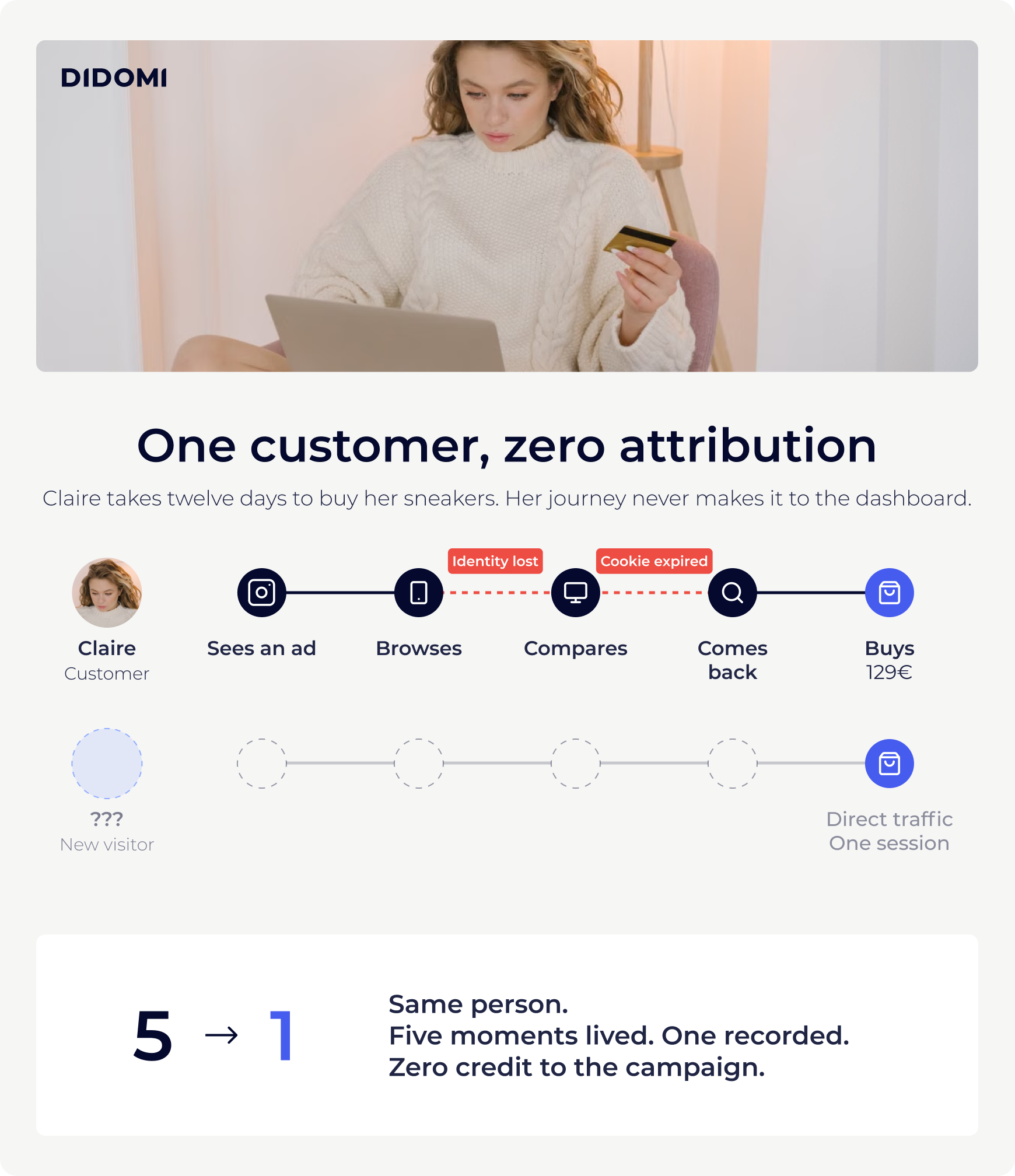
Claire is scrolling through Instagram on her iPhone on a Tuesday evening when an ad for a pair of sneakers catches her eye. She taps, lands on the product page, browses for a few minutes, and closes the app. Later that week, she compares alternatives on her laptop during a lunch break. She is not in a hurry; the sneakers are quite expensive, and she wants to be sure.
Twelve days after that first tap, she is sure. She opens Safari on her phone, types the brand name, finds the sneakers, and buys them.
Here is what the measurement saw:
- The cookie set during her Tuesday visit expired on day seven, well before she came back.
- Her laptop session was never connected to her phone in the first place. A different device and identity, with no thread between them.
- Part of what was captured along the way came from tags that fired before she made her consent choice, so even those fragments cannot legitimately be used.
The dashboard tells a different story from the one Claire lived: It shows a new visitor, arriving via direct traffic, converting in a single session. The Instagram campaign that actually started the sale reports nothing at all, and while finance has the revenue, the warehouse has the order, the marketing team is left with a stranger in an attribution report in which almost none of the touchpoints appear.
How to opt for better: Three ways retailers can fight dead-end data
The pattern from the example above is not an edge case; it is what a normal retail purchase looks like now. Three practices can help retailers deal with it.
Measure the loss before optimizing the spend
Most retailers know their collected data volumes, but very few know their lost ones. Before moving budgets based on attribution reports, establish how much of the journey those reports actually capture by comparing back-office sales against measured conversions, and treat the gap as a number to manage rather than noise to ignore.
Across industries, that gap is large, with, on average, 45% of collected data lost to regulations, ad blockers, and browser restrictions.
Build your data collection on consent, not around it
A consent implementation that fires tags correctly, respects refusals, and transmits clean signals is what separates usable first-party data from the third mechanism above. The goal is not to collect the most data, but to collect data that remains valid tomorrow, under audit, and across markets.
Move measurement into an environment you control
As long as the collection depends entirely on scripts running in the customer's browser, its lifespan is decided by browser vendors and filter lists. Bringing the collection into a first-party, server-managed environment restores durability to the data that customers have agreed to share.
For retailers ready to go deeper on that last point, our guide to server-side tagging tools compares the main options, including Addingwell by Didomi.
How much of your retail data hits a dead end before it reaches your decisions, and do you know where? Chat with our team to find out.