.svg)




If your organization is subject to data protection rules, compliance monitoring can reveal whether your website’s real tracking behavior matches your declared privacy and consent practices. But what do companies typically find when they run a first scan?
What the data says
Based on data from our Advanced Compliance Monitoring (ACM) solution published in our 2026 data privacy benchmark, the average compliance score observed during an organization’s first website scan is 39.6%.
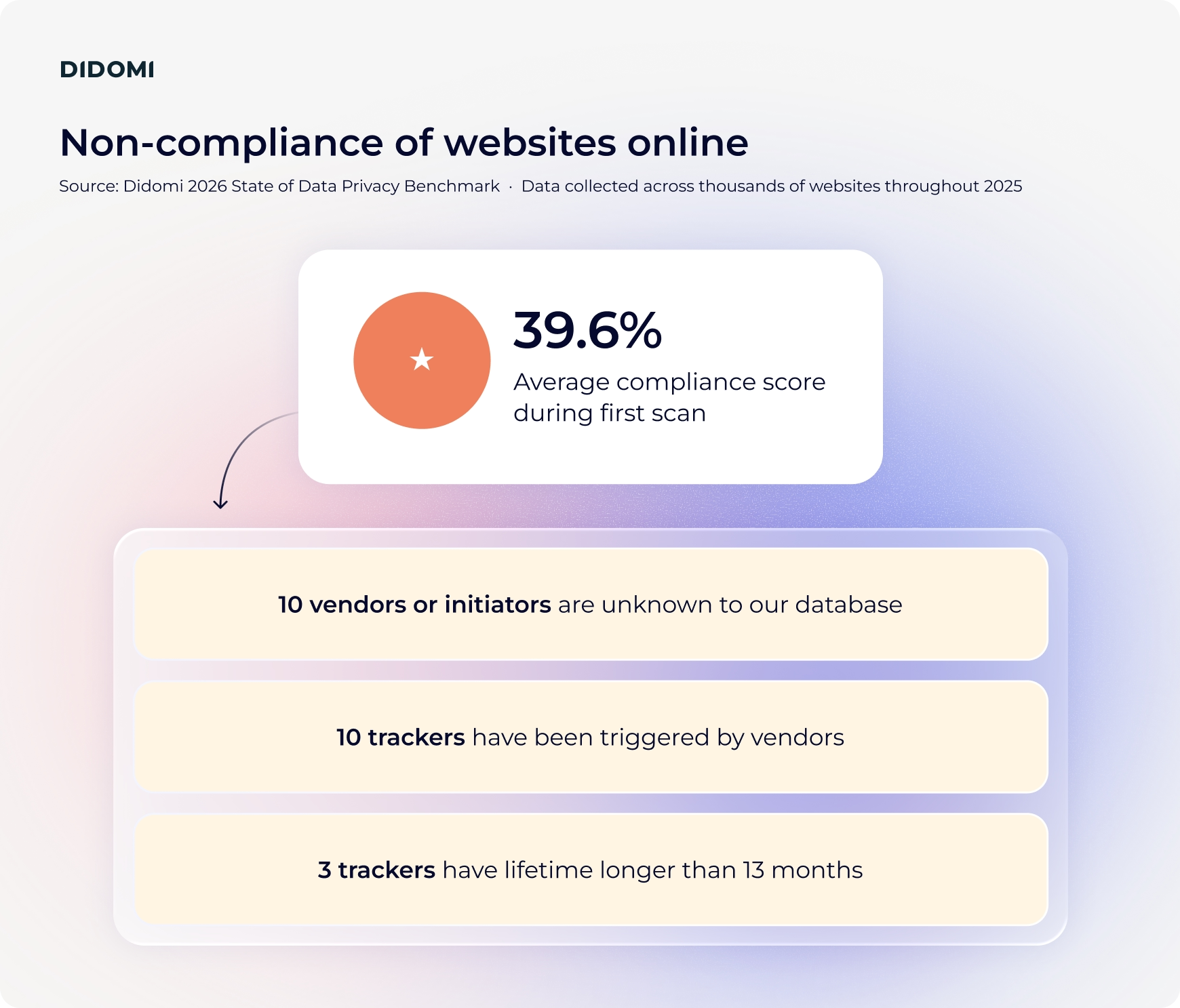
The compliance score is calculated by Didomi’s Advanced Compliance Monitoring solution based on checks including vendor declarations and tracker behavior. The 39.6% figure reflects results from a first website scan, prior to any remediation. More details are available in our full 2026 benchmark.
At 39.6%, the average organization shows significant room for improvement before reaching a stronger compliance posture.
What this means for organizations
If your compliance score falls around or below the 39.6% average recorded at first scan, you are not necessarily in a worse position than most, but you are carrying measurable regulatory risk that your current processes may not be surfacing.
Scores this low rarely reflect deliberate non-compliance but instead typically result from a combination of factors that make accurate vendor and tracker management genuinely difficult:
- Constant changes in vendors and trackers from month to month.
- Conflicting team ownership with a lack of shared process to verify whether what the consent banner promises matches what the website actually does.
- Industry- and organization-specific factors driving unique conditions and use cases.
- Inability for generic compliance tools to detect edge cases and accurately spot risks.
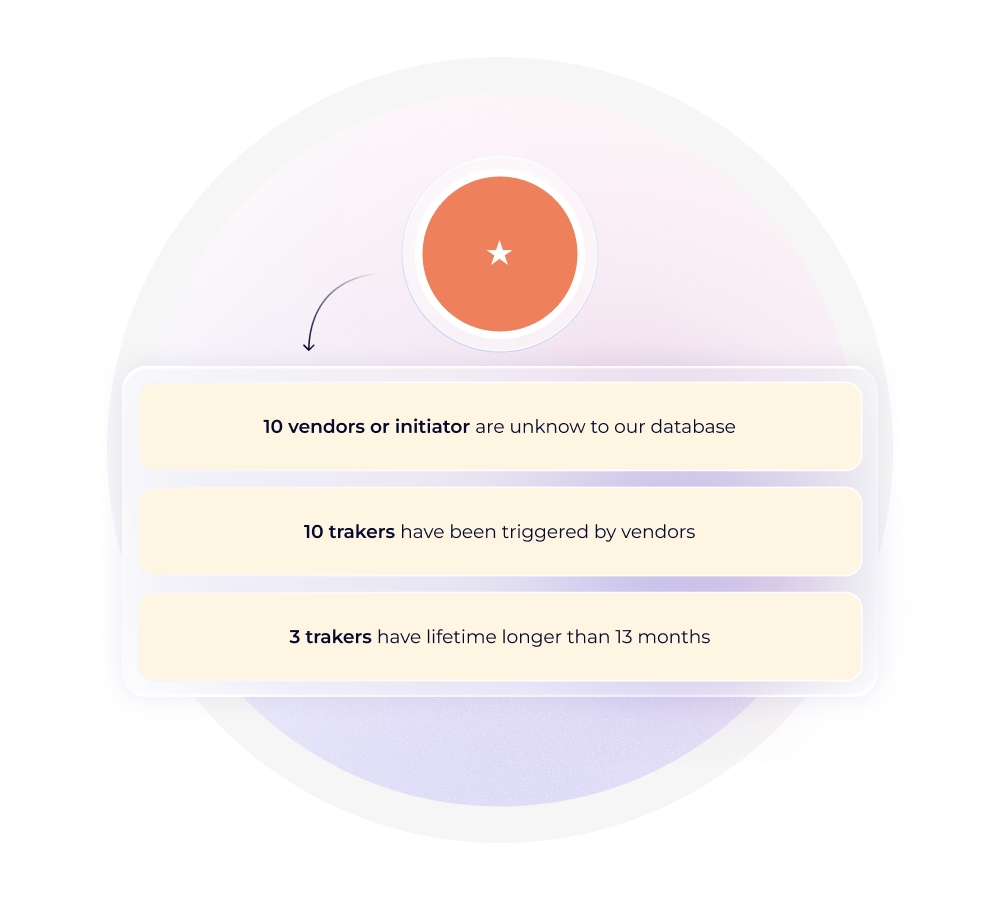
The starting point is establishing visibility by understanding which vendors are active, whether they are declared, and whether your consent signals are being respected. Our Advanced Compliance Monitoring (ACM) solution is built to provide that baseline and surface failure patterns that may otherwise be difficult to detect, including by leveraging AI.

Ultimately, organizations that maintain a strong compliance posture over time are those that treat privacy as a design principle rather than a constraint.
Disclaimer: Keep in mind that compliance scores are shaped by a wide range of factors. Industry, website complexity, vendor stack size, and technical implementation all influence scores significantly. A single benchmark figure is a reference point. Always involve your legal team before making changes based on benchmark comparisons.
What's next for compliance monitoring in 2026?
The benchmark points to widespread compliance gaps. As Teodora Tanase, the Product Manager in charge of our ACM solution, explains:
Most organizations are unaware of the glaring compliance mishaps happening on their digital properties, not by malice, but because of the lack of expertise and reliable technology required to accurately spot them on websites with so many constantly moving parts.
- Teodora Tanase, Product Manager at Didomi
Regulatory scrutiny of vendor and tracker management is intensifying. Enforcement actions in California and continued CNIL and ICO activity in Europe signal that the gap between what a privacy policy states and what a website actually does is increasingly in scope for regulators.
Our team at Didomi continues to develop solutions to help global organizations face these challenges effectively, and to publish updates on enforcement developments and compliance best practices as the regulatory environment evolves.
More data about the state of data privacy in 2026
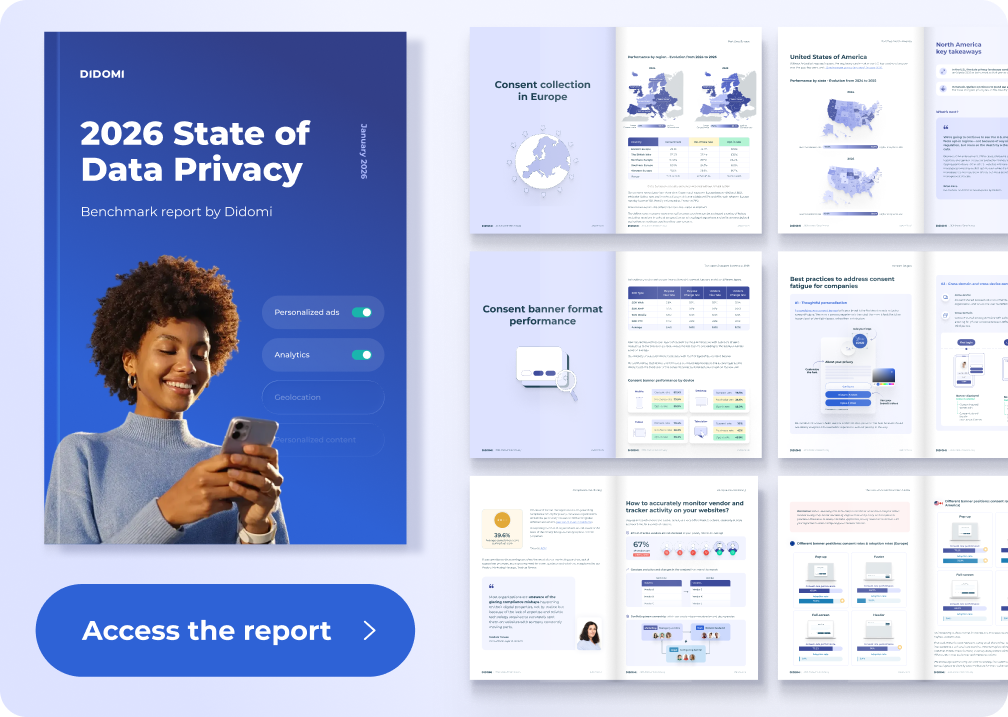
The 39.6% average first-scan compliance score is one finding within a much larger dataset. Our 2026 State of Data Privacy benchmark covers consent collection across Europe and North America, banner format performance, framework adoption, and the full compliance monitoring picture across industries.
Download the full report on our website: