.svg)





This article is written by Shane Donnelly, Data, Analytics and Marketing Technology Leader. Want to share your expertise on our blog as well? Reach out to us at blog(at)didomi.io.
Over the past decade, marketing technology steadily became more accessible. Google Tag Manager (GTM) transformed the operating model by allowing marketing teams to deploy and manage much of their own measurement without waiting for engineering releases.
This article explores how server-side tracking has shifted ownership back towards technology, and the operating model needed to close the resulting gap.
How Google Tag Manager gave marketing greater control
Before GTM, implementing a marketing tag meant writing code directly into a website, scheduling a deployment, and relying on engineering resources. GTM dramatically reduced that dependency, giving marketing analysts and implementation specialists the ability to configure and deploy tags through a relatively simple interface.
The people who understood attribution models, campaign optimization and platform requirements could increasingly manage their own measurement.
It wasn’t perfect. Poorly governed containers became bloated, site performance suffered, there was little documentation, and badly configured tags occasionally caused production issues. But the direction of travel was clear: marketing became more self-sufficient.
Then the industry changed.
Why the old tracking model stopped working
Privacy regulation, browser restrictions, Intelligent Tracking Prevention, ad blockers and the decline of third-party cookies fundamentally altered how data could be collected. Server-side tracking became an important part of the response, offering a more resilient and controlled approach to data collection.
But while server-side tracking helped solve one problem, it quietly created another.
The knowledge of what should be measured still sits with marketing. The knowledge of how to implement it increasingly sits with engineering.
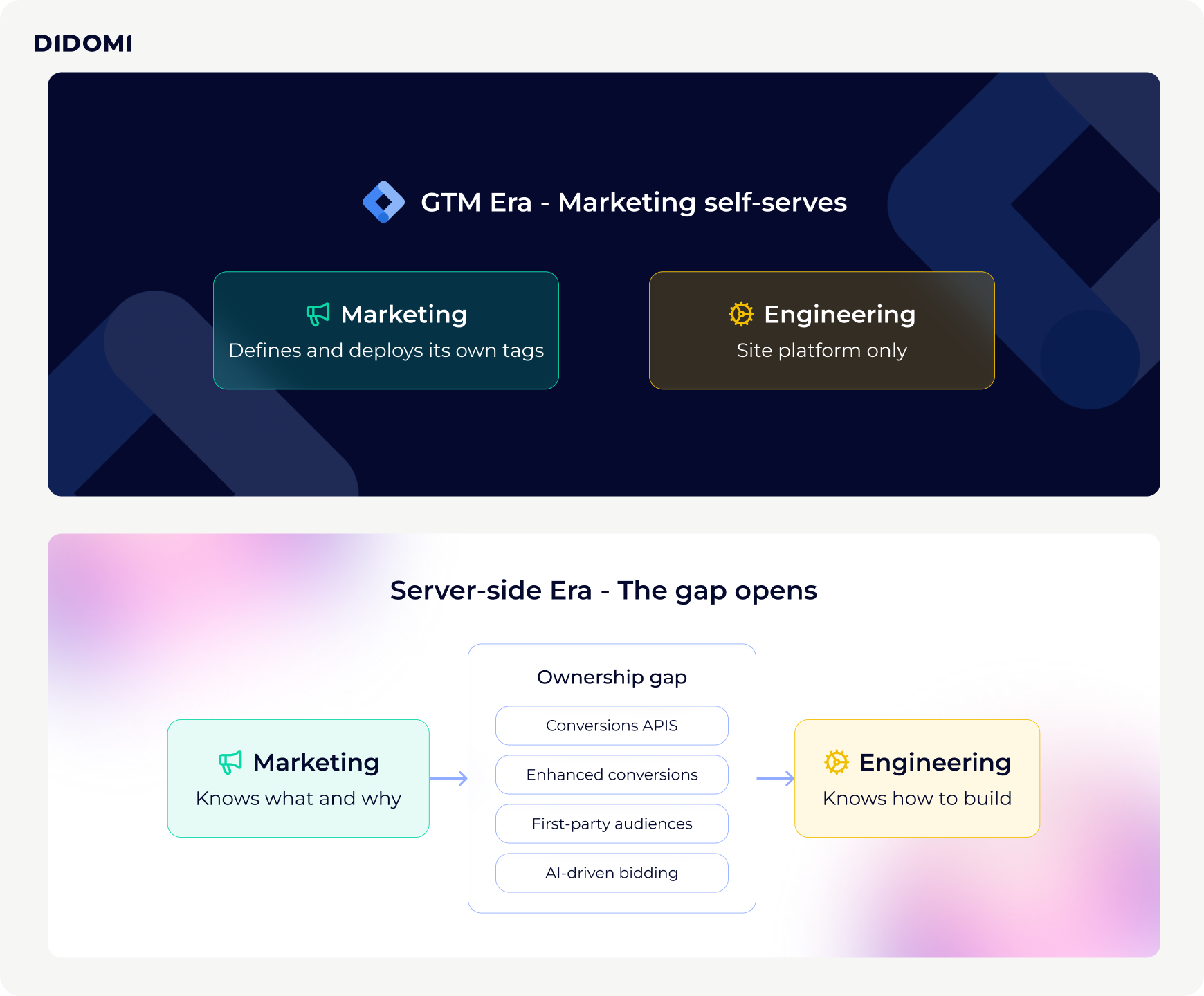
At the same time, marketing teams are being sold a growing range of new capabilities: Conversion APIs, enhanced conversions, first-party audiences, AI-driven bidding and more advanced attribution. The promise is better optimization and stronger performance, but the technical complexity behind these capabilities is often understated.
Marketing may understand the commercial opportunity without knowing which signals, identifiers, consent controls or data flows are required to support it. Technology may understand the implementation challenge without understanding why those signals matter or how advertising platforms will use them.
Marketing therefore sees valuable capabilities it cannot easily activate. Technology sees a growing list of specialist requests competing with other priorities, often without a clear view of the business value.
Closing the ownership gap in marketing technology
The answer is not simply to upskill marketing teams in engineering or technology teams in advertising platforms. The underlying problem is one of ownership.
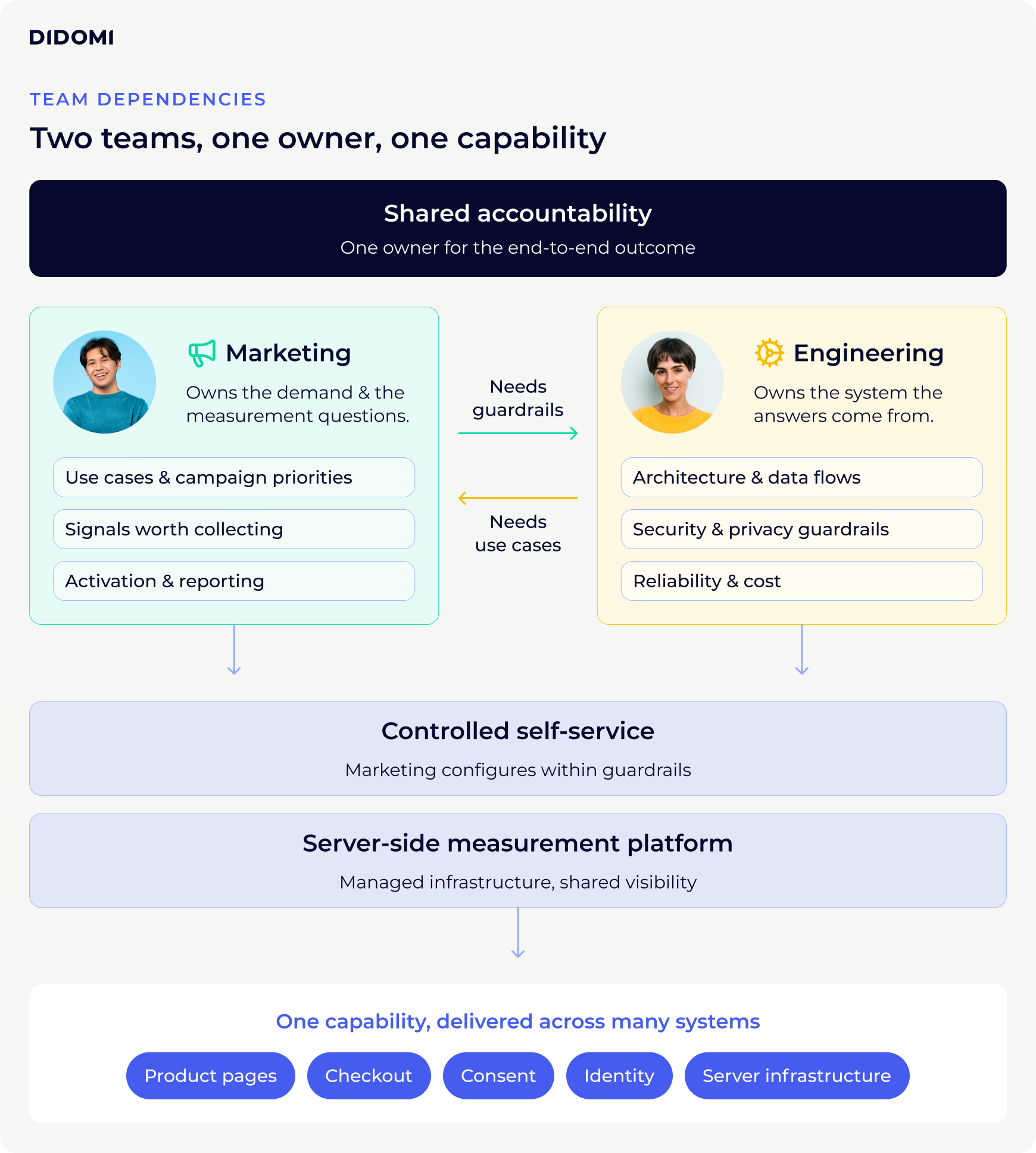
Imagine an ecommerce team wants to implement a Conversion API to improve the signals feeding an advertising platform’s bidding models. From marketing’s perspective, the request sounds relatively simple: send more reliable conversion data and improve campaign performance. But delivering it may require the checkout team to expose new transaction events, the identity team to provide suitable identifiers, the privacy team to define consent rules and the platform team to manage the server-side connection.
Without a shared operating model, each requirement enters a different backlog. Every team can complete its individual ticket while the end-to-end capability remains incomplete, incorrectly configured or impossible for marketing to validate.
These implementations need to be managed as end-to-end measurement capabilities, not collections of separate technical requests. Marketing should own the commercial use case, the signals required and how they will be activated. Technology should own the architecture, security standards and production guardrails. A single accountable owner must then connect those responsibilities and ensure the capability works from the original customer action through to the destination platform.
The responsibility is shared, but the outcome cannot be fragmented.
How to restore controlled self-service
The right technology layer can also help bridge the gap, much as Google Tag Manager empowered marketing teams in the 2010s.
The opportunity is to create controlled self-service. Engineering sets the guardrails, defines a consistent event model and protects the underlying architecture. Within those boundaries, knowledgeable marketing and analytics teams are given the tools to configure destinations, build audiences, activate new channels and validate their own data.
The objective is not to return to an ungoverned world where marketing can deploy anything into production. It is to preserve the speed and domain expertise that made tag management effective while adding the consistency, security and resilience required by modern server-side measurement.
Platforms such as Addingwell can provide part of this enabling layer by managing server-side infrastructure, supporting standardized integrations and giving marketing and technology teams shared visibility into how events and data are flowing.
The value is therefore not only technical. By reducing the specialist work required to operate, monitor and troubleshoot server-side tracking, these platforms can help restore some of the speed and autonomy that made tag management transformative in the first place.
Server-side tracking is not simply a technology deployment. It is an operating-model change.
Organisations that treat it as infrastructure alone will create new dependencies and slower delivery. Those that redesign ownership, guardrails and self-service around it will turn better data into better marketing decisions.