.svg)





This article is written by Olivia Sabbagh, Digital Analyst and server-side tracking expert. Want to share your expertise on our blog as well? Reach out to us at blog(at)didomi.io.
A growing share of the signals your website sends never reaches the platforms they were meant for because ad blockers intercept them, browsers cut them short, and privacy rules reshape what can be collected in the first place. As a result, the measurement layer of your analytics and advertising tools is wrong.
Server-side tagging has become the answer to that erosion, yet most companies that adopt it capture only a fraction of its potential. This article walks through what server-side tagging can actually deliver, and why so many teams leave the biggest gains on the table.
The downfall of client-side tracking
For two decades, web measurement worked the same way, with a piece of code loading in the browser and firing events directly to each tool, whether analytics or an advertising platform.
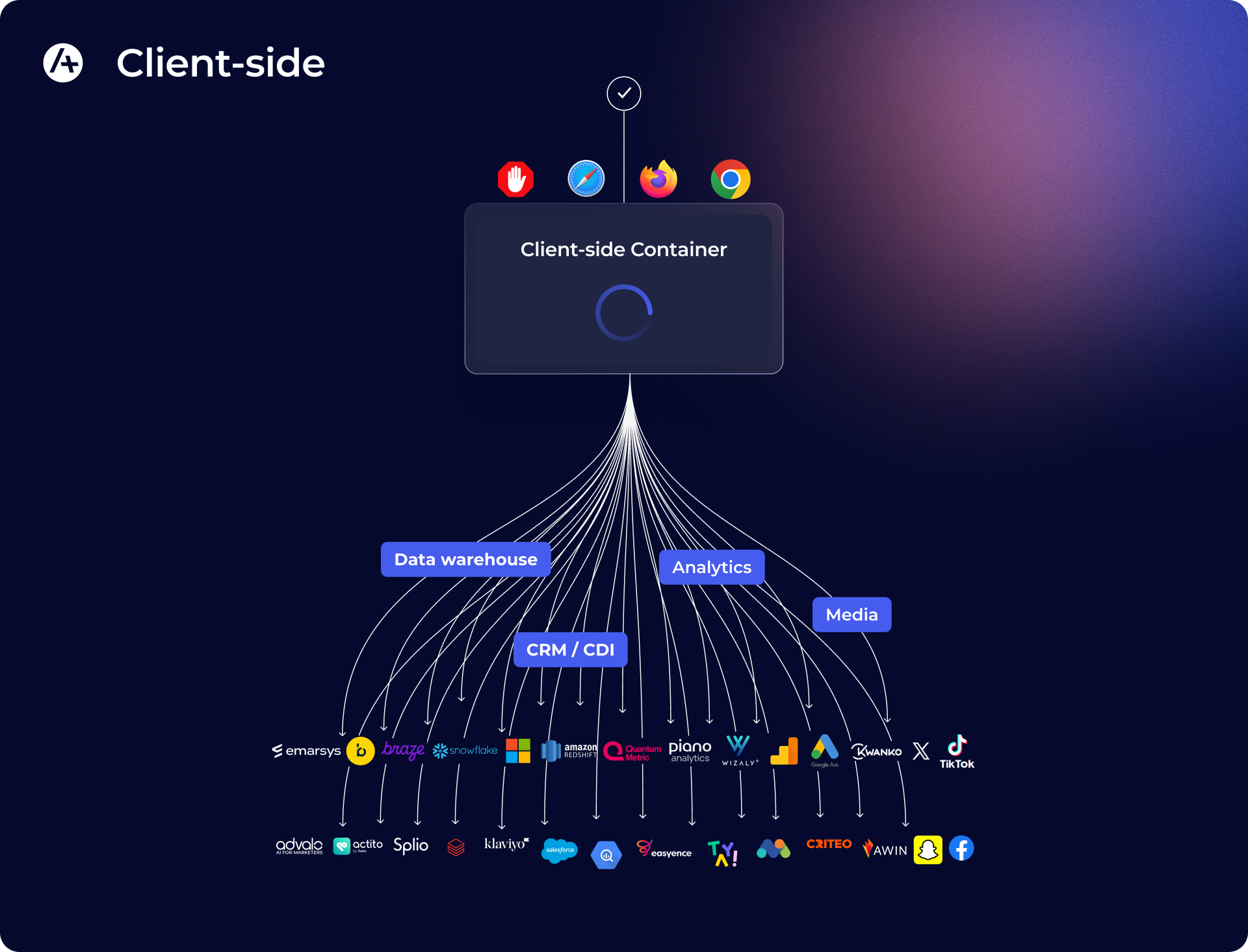
This client-side approach has been challenged by various factors, including three key forces:
- Privacy regulations: Data protection laws like the GDPR in Europe, Law 25 in Quebec, or the CCPA in California made user consent a condition for tracking. That was a needed correction to protect internet users' privacy, but it also means measurement now starts from a smaller, consent-based pool of data, making it more important than ever to protect the quality of that remaining data.
- Ad blockers: A quarter of internet users are estimated to browse with an ad blocker app or browser extension, and contrary to what the name implies, these tools do more than hide ads. By identifying the URLs of common tracking scripts and stopping them from loading, they prevent tracking scripts from firing, even for users who have consented to tracking.
- Browser limitations: Firefox and Brave block third-party cookies by default, and Safari caps cookie lifespans at 7 days, meaning a customer who clicks your ad on Monday and buys ten days later is considered a brand-new visitor. On mobile, where Safari holds significant market share, the attribution damage is substantial.
The combined effect is data you can no longer trust, causing analytics that undercount, return on ad spend (ROAS) you cannot attribute, and retargeting audiences that keep shrinking. Enter server-side tagging.
For a detailed side-by-side of the two models, see our comparison of server-side and client-side tagging.)
What are the benefits of server-side tagging
The idea behind server-side tagging is simple. Instead of letting the browser talk directly to Google, Meta, and every other partner, you place a server of your own in the middle to act as a sorting room for your data.
The server lives within your own domain, either on a dedicated path of your site (for example, yoursite.com/metrics, the approach we currently recommend) or on a subdomain (metrics.yoursite.com), and receives one single stream of events from the browser, then checks, filters, and redistributes them to each platform from the server.
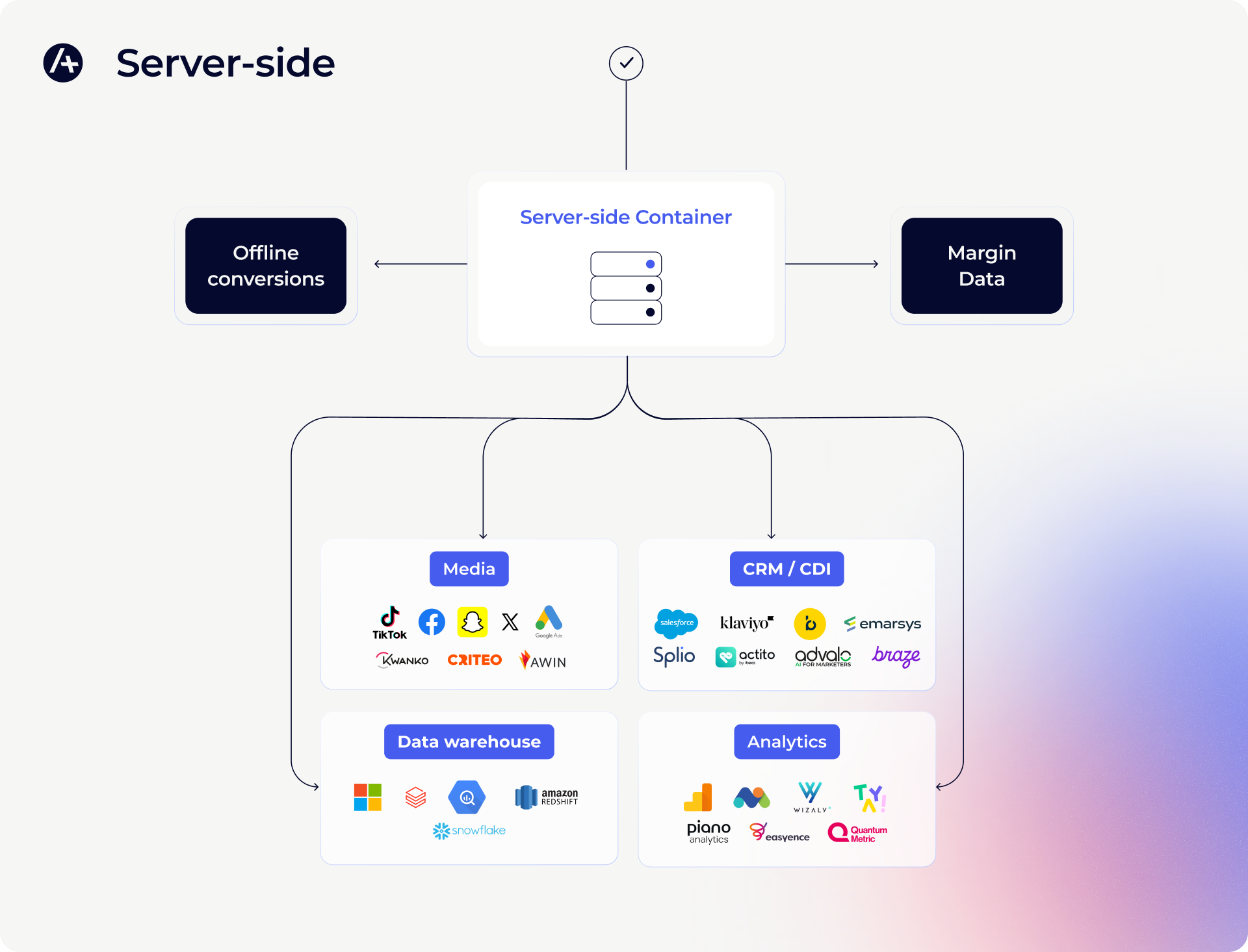
That one architectural change of moving the conversation from the browser to a server you own produces three immediate benefits:
Benefit 1: More complete data collection
Because events stay within your own domain from collection to server, the entire flow happens in a first-party context rather than through third-party calls that browsers restrict.
Advertising platforms now also recommend server-to-server delivery because pixel-only measurement misses too much. See Meta's Conversions API and its equivalents at LinkedIn, Google, TikTok, or Pinterest.
Benefit 2: A faster website
In a client-side setup, every tag means another script loading in the visitor's browser. By moving those tags to the server, the browser loads one script instead of ten. As a result, pages get lighter, which can improve user experience and search rankings, for example, under Google’s Core Web Vitals methodology.
Benefit 3: Real data governance
In a client-side setup, each vendor's script decides what it collects from the browser, leaving you with limited visibility. By implementing a server in the middle, you take back control and can inspect every event, strip out what a partner doesn't need, and document exactly what leaves your infrastructure.
For teams working with a DPO, the approach essentially turns tracking from a black box into an auditable flow.
Note: It’s paramount to insist that server-side tagging is not a way around consent. Your Consent Management Platform remains the entry point of the whole chain, and a visitor who declines tracking must stay untracked.
Advanced benefits and server-side maturity
While migrating away from client-side tracking offers significant benefits, it doesn’t automatically deliver everything server-side can do right away.
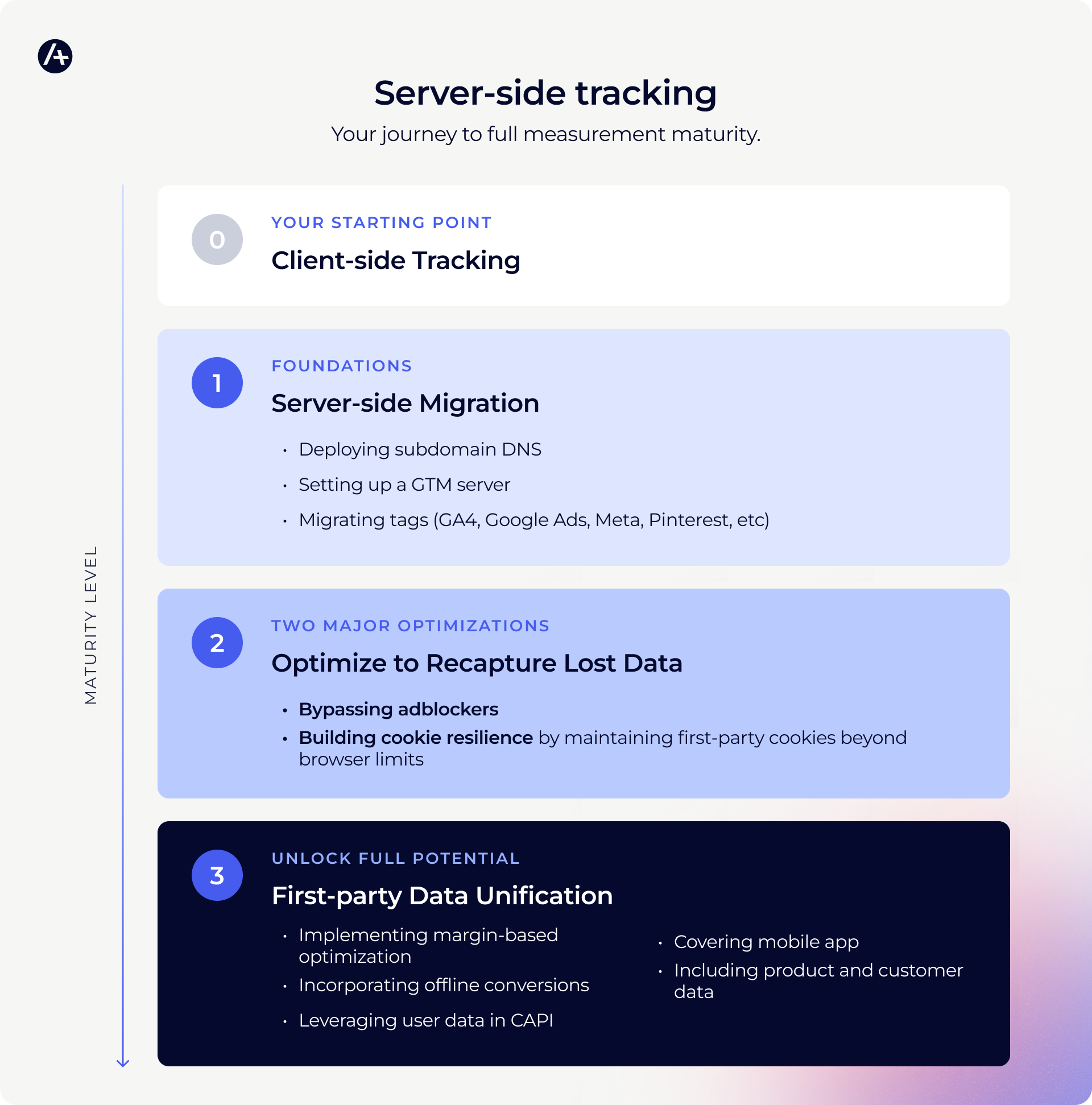
Two things in particular separate a basic setup from a mature one: recovering the data ad blockers and Safari are costing you, and enriching what you send with real business context.
Recovering data lost to ad blockers and Safari ITP
Ad blockers work by matching requests against blocklists built on recognizable signatures, such as googletagmanager.com or /gtag/js, so a default server-side setup that still loads scripts under those names can get caught just as easily.
An advanced implementation, however, can bypass this issue and ensure consented data doesn’t get blocked. Learn more about ad blockers and their impact on your marketing operations:
{{didomi-adblockers-marketing}}
Safari Intelligent Tracking Prevention (ITP) offers a different kind of resistance by capping script-set cookies at seven days, even when the script loads from your own domain. You can address this by implementing a reverse proxy that routes requests so they are recognized as genuinely first-party, or by using a Cookie Restore mechanism that sets a master cookie at the domain level and re-links returning visitors to their marketing cookies after the standard seven days have passed.
Addingwell by Didomi allows for these fixes, with regular upkeep that stays on top of the constant updates from both ad blockers and Safari. Check out our case studies to learn from customers that have implemented our solutions and seen results:
{{addingwell-case-studies}}
Enriching signals with real business data
Once your collection is complete and reliable, you can take additional steps that improve advertising performance by moving from transmitting data to enriching it.
Google and Meta don't lack data, but their algorithms need signal quality and the business context that tells them which conversions actually matter to you. That context lives in your CRM and your ERP, not on your website, and a mature server-side setup is the pipe that carries it to your platforms.
Two examples show what this means in practice:
Optimizing for margin instead of revenue.
By default, your campaigns optimize for conversion value, and the algorithm chases the biggest carts. But a big cart full of low-margin products can be worth less to you than a modest cart of profitable ones. Send product margin data through your server, and the algorithm starts chasing profitability instead of turnover.
Connecting offline sales to online campaigns.
A customer sees your ad, researches online, then buys in a store or over the phone. To your platforms, that campaign produced nothing. Feed offline conversions back through your server, and those sales are finally attributed to the campaigns that generated them.
---
Addingwell by Didomi regularly publishes case studies with clients that have observed tangible results: Damart recovered 16% more data by optimizing collection across the group. Sandaya improved its ROAS by 33% by making its advertising signals more reliable. Maisons du Monde grew campaign revenue by 12% by feeding margin data into its bidding.
For a step-by-step view of this progression, from first migration to full enrichment, read our guide to getting the most out of your server-side setup.
How to get started with server-side tagging
Today, migrating to server-side tracking is increasingly common, but how far you take it will make a difference. By pushing to complete collection and enrich signals, you’ll be able to compete with data your competitors can't access.
Didomi covers that whole chain, with consent as the entry point, and server-side tracking as the collection and enrichment layer behind it. Explore our server-side tagging solution or talk to our team about where your setup stands today:
{{talk-to-an-expert}}