

CIPA compliance
CIPA is rewriting the rules on tracking and recording.
CIPA compliance
CIPA is rewriting the rules on tracking and recording.


$5,000
Max penalty per violation
1967
Enacted, still in force
All-party
Consent required
Trusted by thousands of companies worldwide








What it is
A 1967 wiretapping law now targets modern tracking
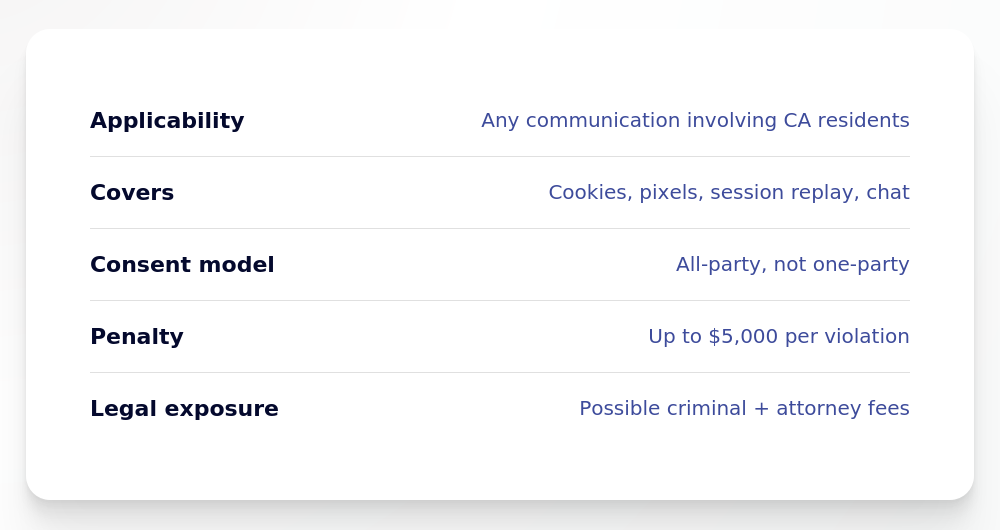
CIPA (Cal. Penal Code § 630 et seq.) bans recording confidential communications without every party's consent. Written for landlines, it now covers cookies, pixels, session replay, and chat tools. Unlike federal law's one-party consent rule, California requires all-party consent, every participant in a confidential communication must agree to being recorded.
Where claims come from
Three recurring fact patterns in current CIPA litigation


Risk mitigation
One CMP for all six operational controls
The operational program that reduces CIPA exposure, in a single platform.
1. Consent & transparency
Notice before collection, not after. Store consent states, timestamps, and notice versions as evidence.
2. Minimize collection
Only what's needed, only when needed. Audit high-risk inputs and mask sensitive fields.
3. Vendor governance
Every tag inventoried and controlled, activated by consent state and matched to contracts.
4. Monitoring & change control
Catch drift before it becomes exposure. Govern new tags before launch and run regular audits.
5. Team training & escalation
Everyone knows what to flag, and to whom. Clear rules on what "do not deploy" means.
6. Defensible posture
Proof, on record, when a claim arrives. Consistent, documented, and reviewable without rebuilding.
How Didomi helps
A consent management platform
built for exactly this kind of exposure
Consent, notice, and proof, without slowing your stack down
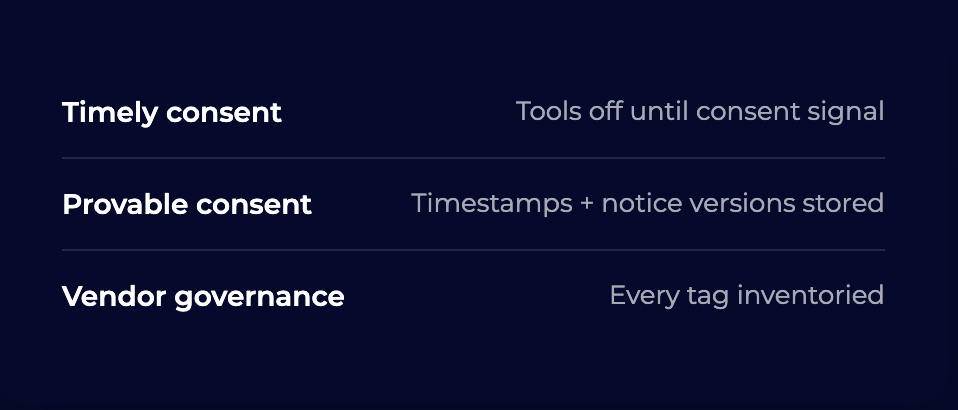
Didomi's CMP gives you the timing, notice, proof, and vendor governance a defensible CIPA program requires, in one place.
Didomi blocks tools until the right consent signal is collected, stores every consent state and notice version as evidence, and keeps a live inventory of every vendor tag activated by consent state, the exact record a defensible CIPA program requires.
Implementation
How to become CIPA compliant with Didomi

Scan your site, map vendors and purposes, import current consent.
.webp)
Frameworks, regions, branding, and California-specific consent signals.
%20(1).webp)
Google Tag Manager, analytics, ads, block every tool until consent.
-1.webp)
Analytics dashboard, audit-ready exports, and ongoing experiments.
Why teams choose Didomi
One platform. Every regulation. Every channel.
Built for teams who can't afford to choose between compliance and performance.
Multi-regulation coverage
CPRA/CCPA, LGPD, GDPR, DPA, etc., ready for other US state laws, so you don’t have to worry about what’s changing next.
Google Consent Mode v2
Seamless Google Consent Mode v2 integration (protect measurement while staying compliant). Keep your analytics alive as privacy evolves.
Built to scale globally
Multi-language, multi-brand, multi-region, multi-domain setup for fast global rollout. Because scaling shouldn’t mean starting over.
Customization
Fully customizable UX to lift opt-in rates (and trust).
Advanced Compliance Monitoring
Audit-ready reporting and consent proof exports for regulators and DPOs.
Partnership level support
Highly responsive, guided onboarding, technical setup support and continuously improving your consent performance.
Why choose Didomi for your Consent Management Platform?
A global leader in consent and data privacy, our CMP helps you comply with international data privacy regulations, regain your customers' trust, and generate revenue.
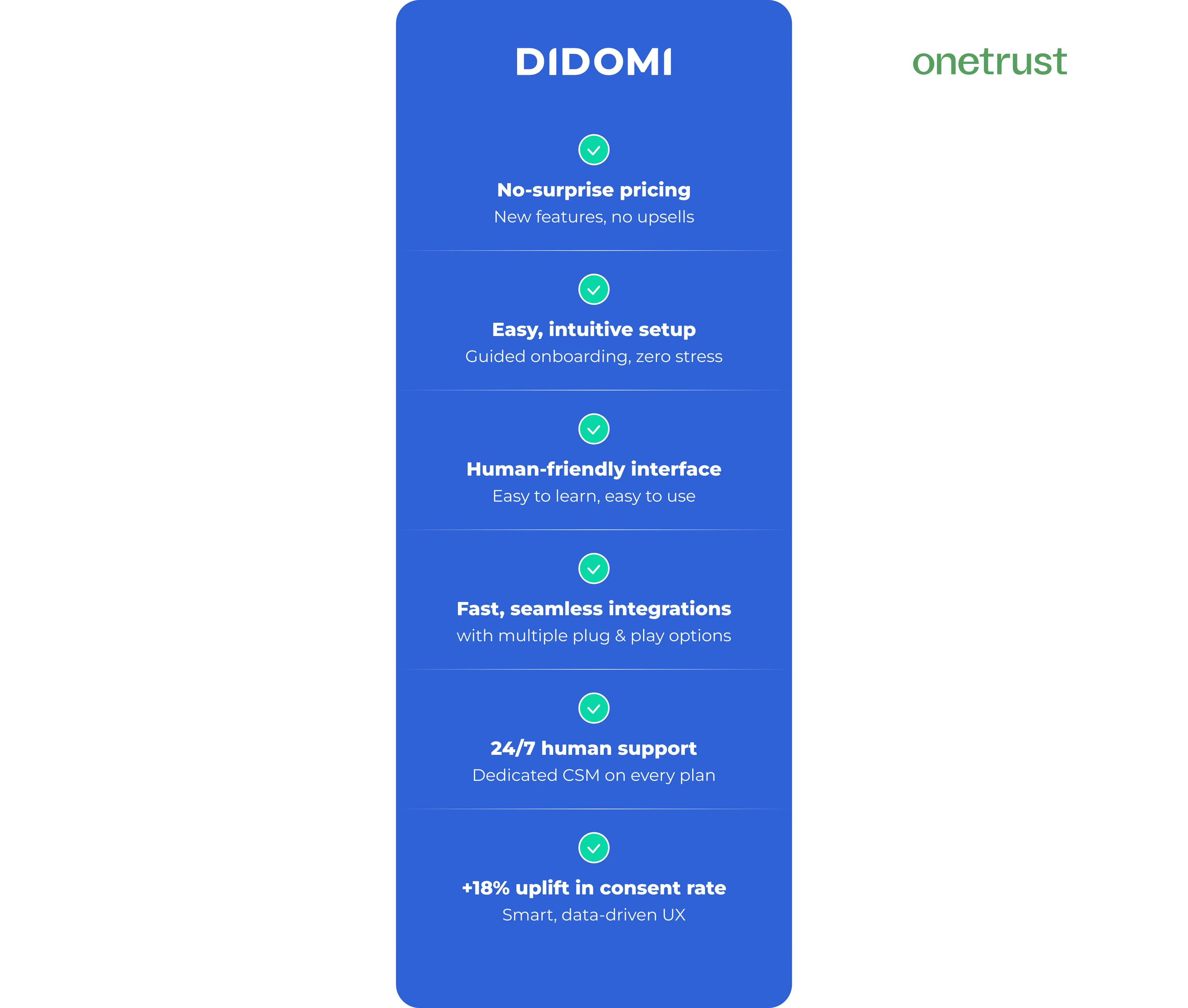

Why companies opt for betterconsent management with Didomi

Lead tracking at Europcar
%20(1).svg)
Web Analytics Project Manager

10%lower latency
Analytics & CRO Team Lead
See where your CIPA exposure sits today

A 30-minute conversation to cover how Didomi privacy unblocks teams and supports revenue growth
A live demo of our products, personalized to your organization’s specific needs
All your questions answered, with no commitment
Fill out the form to talk to a Didomi expert and begin your journey.